Shelf Life
Jürg Lehni
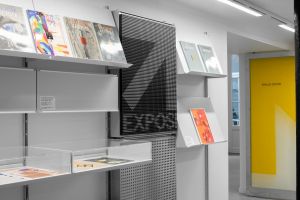
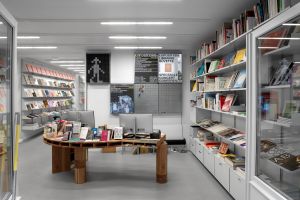
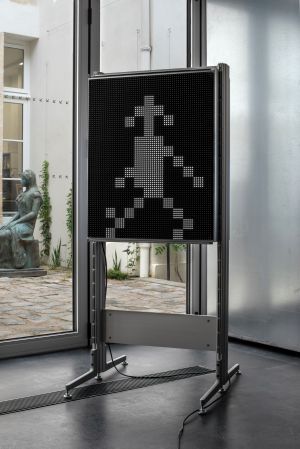
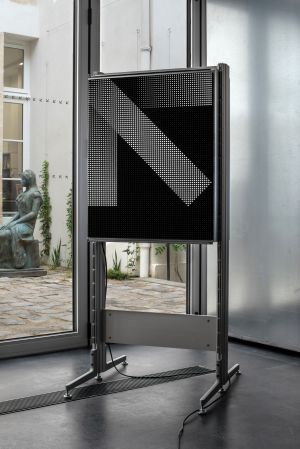
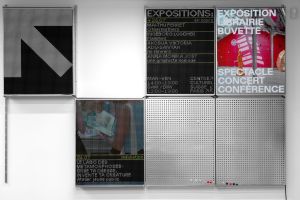
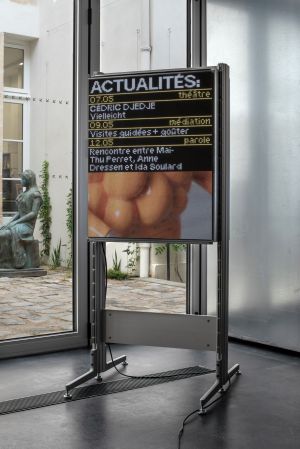
Shelf Life (2026) is a signage system and artwork created by Jürg Lehni in collaboration with Marietta Eugster and Clément Rouzaud for the Centre culturel suisse.Paris. The work borrows the folded sheet-metal design of Dieter Rams’ 606 Universal Shelving System for Vitsœ — a totem of functionalist design — and turns it on its head: stretched to the size of a screen, these custom-made units are equipped with industrial RGB LED panels, such as those mass-produced in Shenzhen for billboards and storefronts. Where the powder-coated original is smooth and elegant, Shelf Life is made out of galvanised steel — the raw, crystalline coating of air ducts and cable trays, infrastructure rather than furniture.
The screens come in three resolutions (pixel sizes of 2.5mm, 5mm, and 10mm) as a kind of typographic hierarchy in hardware: legible up close, across the room, across the street. No longer carrying objects, they now carry information, becoming part of the institution’s identity while remaining works in their own right.
Shelf Life is at once a tribute and a gentle bootleg, both celebrating and complementing the original, and giving it new use. As in Four Transitions (2020), the work finds a poetry in technology: in how the tools we invent to communicate come to shape the character of what appears — and how long anything, a screen, a standard, a classic, stays good for.